







The Hidden Technology Behind the 2026 FIFA World Cup That Could Change Football Forever
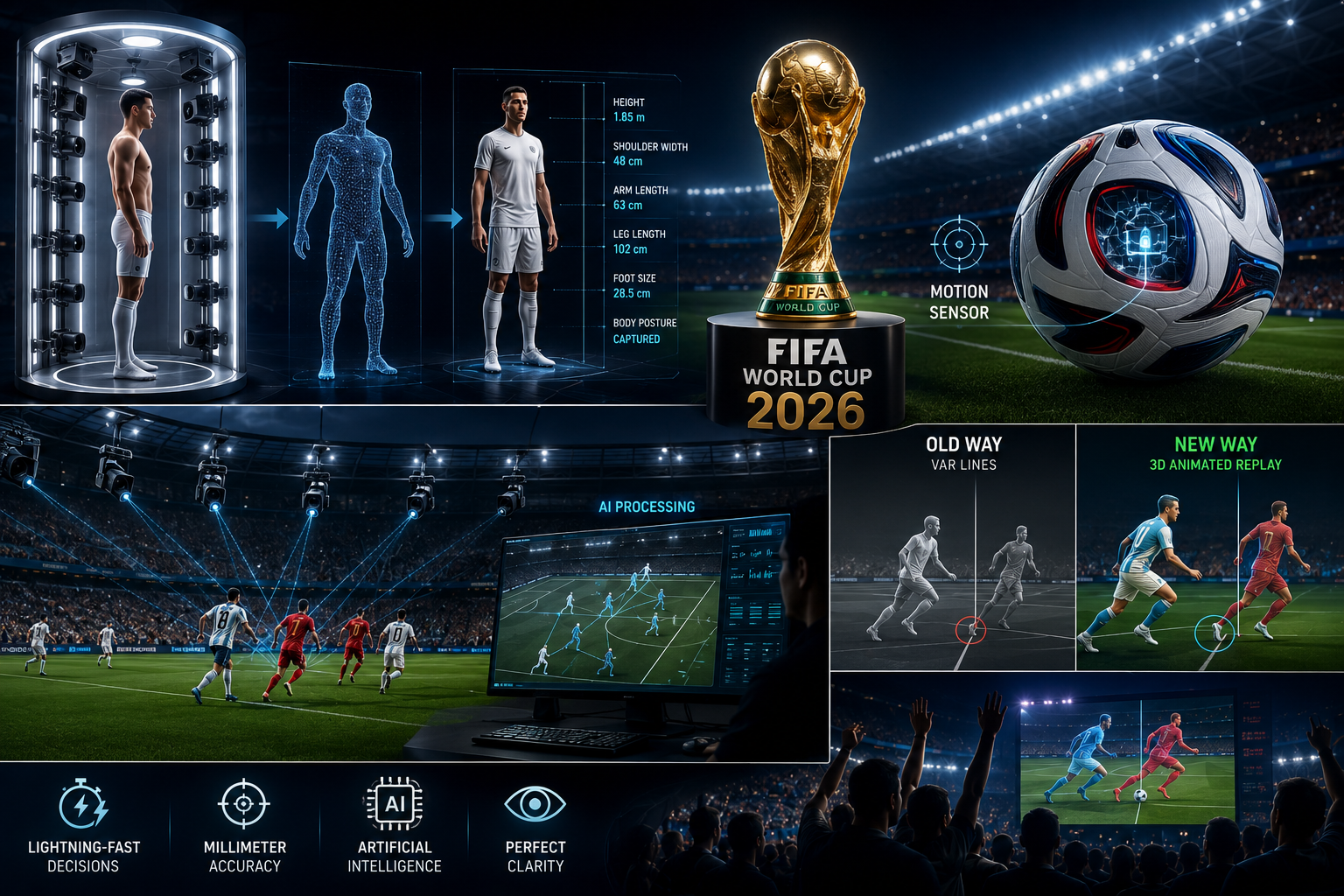
Imagine standing in front of a machine for just one second and having an exact digital copy of your body created. That’s exactly what FIFA did at the 2026 FIFA Men’s World Cup. Before the tournament began, all 1,248 players were digitally scanned using multiple high speed cameras that captured hundreds of images in an instant. Advanced computer vision software then transformed those images into highly accurate three dimensional “Digital Twins” of every player. FIFA also created realistic 3D digital avatars, giving football technology the ability to understand the exact body shape and proportions of every footballer for the very first time.
But FIFA didn’t do this just because it looks cool. It was built to solve one of football’s biggest problems, offside decisions. Instead of relying on estimates and generic player models, the system now knows the precise position of every player’s shoulder, leg, foot, and body posture in real time. This means controversial offside calls that once took minutes to review can now be determined with incredible accuracy, down to just a few millimeters.
The Digital Twins are only one piece of an extraordinary technological ecosystem. Sixteen high speed cameras around the stadium continuously track every player’s movement, while artificial intelligence processes the data instantly. Even the official match ball contains a tiny motion sensor that detects the exact moment it is kicked. Combined with Hawk Eye technology, FIFA can recreate every moment of play in three dimensions, delivering lightning fast automated offside calculations within seconds while referees remain in complete control of the final decision.
Perhaps the most impressive part is what fans now get to see. The unpopular flat VAR lines are being replaced with lifelike three dimensional animated replays shown on television broadcasts and stadium big screens, making offside decisions easier than ever to understand. Beyond football, Digital Twin technology is already being explored in medicine, sports science, fashion, rehabilitation, and filmmaking. The 2026 FIFA World Cup will be remembered not only for the football that was played, but for proving that a one second body scan may have changed the future of football forever.